

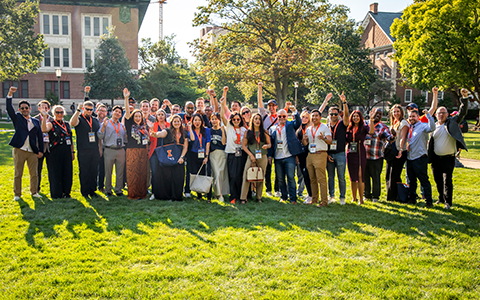
When Gies College of Business launched the iMBA® a decade ago, it set out to prove that world-class business education didn't have to carry a steep price tag or force you to put your life on hold. As we celebrate the program’s 10th anniversary, we’re sharing the different paths our alumni have taken along the way.
In Part One, we checked in on creative leaders who are redefining brand strategy. In this installment, we explore a pivot almost every mid-career professional faces -- moving beyond subject matter expertise to take on broader leadership roles backed by fluent mastery of finance, high-level strategy, and change management.
Here’s how four early Gies iMBA® graduates used their degrees to bridge that gap and drive real transformation in their organizations and industries.
The systems innovator mindset: Valerio Cerron

Throughout his career in business operations and claims management across major insurance carriers, Valerio Cerron noticed the same mistake surfacing again and again in corporate restructuring.
“The cookie-cutter approach is probably what happens the most,” said Cerron, director of shared services and business transformation at Venbrook. “You think something that’s worked before for someone else will work the same for a new enterprise or corporation, and everybody has a unique set of challenges.”
When Cerron enrolled in the Gies iMBA, he was looking for a program with the flexibility to keep working full time, plus the brand recognition and worldwide network that would make the investment pay off. Of everything he considered, Gies Business offered the strongest combination of the three.
One course in particular has stuck with him. In her operations coursework, Prof. Fataneh Taghaboni-Dutta taught Spear & Bowen’s diagnostic rules for analyzing a process: How do you do this work? How do you know you’re doing it correctly? How do you know the outcome is free of defects? What do you do when you have a problem?
“I still run those four questions against every process I inherit,” said Cerron, about his approach to streamlining shared services and guiding organizations through technological evolution without sacrificing operational stability or employee alignment.
“At the end of the day, all these organizations are made out of people” he added. “The knowledge and expertise that everybody brings—acknowledging that and using it to shape the future—is what makes it unique. That’s the secret sauce.”
The strategic catalyst lens: Ira Andhare
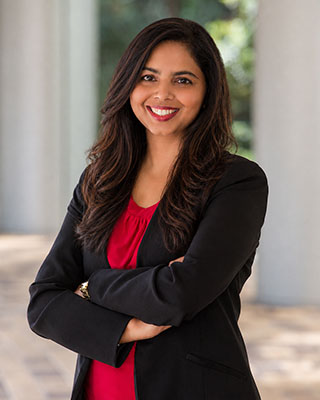
For years, Ira Andhare thrived in traditional IT and technical program management across global energy and manufacturing firms like Chevron Phillips and LyondellBasell. But as digital landscapes evolved, she realized that technical proficiency was only half the equation—driving enterprise technology initiatives required speaking the language of executive decision-makers.
That realization sent her looking for an MBA program. Weighing the decision against closer options like Rice and UT Austin—while balancing two young kids and a full-time job—Andhare found the choice came down to fit as much as prestige.
“The University of Illinois' reputation gave me confidence in the program’s quality,” she said. “The Gies iMBA® offered an exceptional education at a cost that made it a compelling choice.”
That bet paid off almost immediately. Enrolling in the Gies iMBA® allowed Andhare to immediately apply classroom insights—from negotiation and strategy to M&A review and sustainability lifecycle analysis—to complex workplace scenarios. Armed with cross-functional fluency, she stepped into chief-of-staff responsibilities, commercial planning, and eventually an AI strategy role, while also serving as sustainability lead for Chevron Phillips’s commercial and R&D organization.
“I brought that business strategic leadership perspective for technology transformation when I came back into IT,” said Andhare. “The EV stuff was new to me. Sustainability was new to me. Digital transformation, AI was new to me. So, that strategic perspective and lens to navigate ambiguous and continuously evolving business environment is what I really got from the Gies iMBA.”
Andhare says that lens shows up in unexpected places, too.
“It’s not only for the job – it goes everywhere—even negotiating with kids,” she said.
Andhare’s strategic approach now guides large-scale digital transformations and M&A integration at Crane. And she extends her expertise to her work as a board member of the Collaborative for Children, a Houston-based non-profit focused on early childhood education.
“I now think of my work as a reflection of my personal brand,” she said. “Every project I deliver and every transformation I lead is an opportunity to build trust by consistently delivering quality and value. Geis iMBA® enabled that for me.”
Human-centered agility: Lotus Buckner
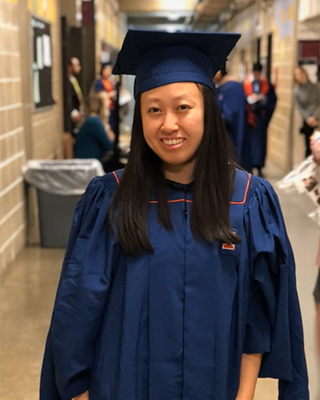
When Lotus Buckner entered the iMBA program, she brought extensive hands-on experience in human resources, IT management, and organizational leadership. However, as she stepped into executive responsibilities—including standing up a COVID-19 command center in under 24 hours, redeploying 400 employees and coordinating more than 800,000 donated supplies, and overseeing multi-billion-dollar operational scopes—she recognized that leadership intuition needed to be paired with rigorous business analytics.
“One of the best things about this program is that the professors teach the content in a way that is so immediately applicable,” said Buckner, founder and CEO of LB Talent Solutions and author of The Joy of HR.
The proof came in her statistics class, a subject Buckner had struggled with as an undergrad.
“I pulled out my work laptop in the middle of a lecture and thought, ‘I bet I could use these formulas to do this,’” she said. “When you’re talking about immediate, that was immediate.”
Buckner also leveraged the program’s emphasis on “business for good” to rethink how organizations handle structural change and talent development. Rather than relying on static HR policies, she designed agile, human-centered systems that adapt to individual employee needs while driving top-line business goals.
“Change never happens because someone did something popular,” said Buckner. “Change happens because someone did the unpopular thing. Someone did the thing that was not the average.”
That same conviction extends to the community she’s built through the program. On a vacation to Tokyo, she posted in the program’s alumni network asking for restaurant recommendations—and ended up being hosted for dinner by a local alum, with two more flying in from Chicago and Dubai just to meet her.
“There’s nowhere I travel in the world where I don’t meet up with MBA students or MBA alumni,” she said.
Ten years and a bestselling book later, she concludes: “Because of the MBA, I’m less worried about what comes next.”
Enterprise strategy: Jackie Price Osafo

When Jackie Price Osafo made the decision to earn her MBA, her goal was clear—acquire the financial and strategic mastery required to guide non-profit organizations through complex, changing environments.
“My purpose for getting my MBA was so that I could sit in a space in the C-suite,” said Price Osafo, CEO of the Society of American Archivists (SAA) and the SAA Foundation. “Deciding to pursue this program with Gies Business was up there with the top 10 decisions in my life—not just professionally, but in my life.”
As a non-profit executive, Price Osafo quickly put her coursework into action, steering SAA through its first dues increase in a decade, a shift toward more advocacy work—now roughly 40% of her time, up from 10–15%—and a new strategic plan. She credits the program's strategy and leadership courses with helping her navigate that shift.
“Strategy keeps you focused and helps everyone stay away from mission creep,” said Price Osafo. “As we learned from an HBR case study, strategy is ultimately an agreement by the organization on how they’re going to deliver value. Sometimes they don’t need 50 things to do—they need four things to do. And those four things then give them the flexibility to change, adjust, and adapt as they need to.”
By pairing mission-driven advocacy with financial and operational rigor, Price Osafo continues to position her organization for long-term stability and sector leadership.
Her advice to anyone weighing the leap to earn a mid-career advanced degree?
“Be fearless in anything and everything that you do,” she said. “If you’re on the fence and you’re fearless, it’s for you.”
A decade of developing executive leadership
Ten years after aunching as a radical experiment in online business education, the Gies iMBA® has demonstrated that accessibility and academic rigor can coexist at scale. What began with an initial class of 114 students has grown into a global community of more than 7,000 active learners and a powerful alumni network spanning top international businesses and non-profit institutions.
This educational framework has served as the foundation for the College's expanding suite of specialized online stackable credentials, graduate certificates, and the newly introduced online Master's in Business Analytics degree, continuously broadening access to world-class business instruction.
"The true measure of the iMBA over this past decade is the leadership of our alumni," said Brooke Elliott, Dean of Gies College of Business. "Valerio, Ira, Lotus, and Jackie show what happens when functional expertise meets real business strategy-- leaders who bring clarity and purpose to a complex global economy."